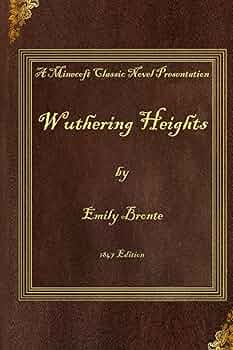
Emily Brontë’s Wuthering Heights occupies a singular position in the history of the novel because its psychic architecture appears uncannily aligned with psychoanalytic theory decades before Freud formalized its concepts. The text does not merely depict intense passion; it stages melancholic identification, repetition compulsion, the instability of ego boundaries, and a sustained attraction toward annihilation. Read psychoanalytically, the novel becomes less a romance than a structural exploration of incorporation, drive, and the catastrophic refusal of separation.
This essay approaches the novel through four theoretical coordinates: Freudian melancholia, repetition compulsion and the death drive, object-relations theory, and Lacanian formulations of desire and the Real. Throughout, the argument will emphasize that Brontë’s achievement lies not simply in psychological depth but in constructing a narrative form that behaves like a symptom.
I. Melancholic Identification: Love as Incorporation
Freud’s essay “Mourning and Melancholia” (1917) provides the foundational conceptual distinction for reading the Catherine–Heathcliff bond. In mourning, libido gradually withdraws from the lost object. In melancholia, by contrast, the subject internalizes the lost object through identification; the ego incorporates what it cannot relinquish. The result is not resolution but impoverishment and self-division.
Catherine’s declaration that she and Heathcliff are indistinguishable signals precisely this structure. The statement is not hyperbolic romance but ontological collapse. The beloved is not desired as other but as constitutive of selfhood. Such identification makes separation intolerable because it threatens ego disintegration.
Heathcliff’s response to Catherine’s death exemplifies melancholia’s refusal of mourning. He demands haunting, not closure. He implores the dead to remain present as persecutory force. Freud notes that melancholia transforms loss into a sustained internal attack; Heathcliff externalizes that attack in his insistence that Catherine’s ghost disturb him perpetually. The haunting is not supernatural embellishment; it is the formalization of melancholic incorporation.
Thus, love in Wuthering Heights is not relational but incorporative. It abolishes alterity and produces a structure in which loss equals annihilation.
II. Repetition Compulsion and the Structure of the Double
In Beyond the Pleasure Principle (1920), Freud identifies repetition compulsion as a drive that exceeds pleasure-seeking. The subject unconsciously reenacts traumatic situations rather than remembering or mastering them. The second generation in Brontë’s novel functions precisely as such reenactment.
The structural doubling—Catherine/young Catherine, Hindley/Hareton, Heathcliff/Linton—should not be treated as mere narrative symmetry. It is symptomatic repetition. What the first generation fails to resolve returns in modified form. Property conflicts, emotional domination, and frustrated attachments recur as if governed by an internal law stronger than conscious intention.
This structural compulsion suggests that trauma in the novel is transgenerational. The violence of incorporation and rivalry cannot be contained within individual psychology; it inscribes itself into familial lineage. Narrative itself becomes the vehicle of repetition. The novel does not describe compulsion; it performs it.
III. The Death Drive and the Erotics of Dissolution
Heathcliff’s desire repeatedly exceeds erotic fulfillment. His longing is not satisfied by possession, revenge, or dominance. Instead, it intensifies toward dissolution. Freud’s speculative concept of the death drive—the impulse toward inorganic stasis—illuminates this trajectory.
Heathcliff’s fantasy of reunion with Catherine beyond death collapses Eros into Thanatos. The desired union is not social or sexual but metaphysical annihilation of difference. Love becomes indistinguishable from destruction. The novel’s Gothic landscape reinforces this psychic movement: the moors are barren, wind-swept, resistant to cultivation. They externalize a psychic economy stripped of mediating structures.
Unlike Victorian domestic fiction, which stabilizes desire within marriage and property, Wuthering Heights dismantles social containment. Drive overwhelms symbolic order. Heathcliff manipulates inheritance and marriage not to integrate into society but to hollow it out from within. Social law becomes an instrument of compulsive repetition rather than ethical regulation.
The novel thus anticipates the Freudian insight that drive operates beyond pleasure, beyond morality, beyond social coherence.
IV. Object Relations: Pre-Oedipal Fusion and Splitting
While Freudian theory clarifies melancholia and repetition, object-relations theory deepens our understanding of the Catherine–Heathcliff dyad. Melanie Klein’s concepts of splitting and persecutory anxiety are particularly relevant.
The early bond between Catherine and Heathcliff resembles pre-Oedipal fusion. The anxiety governing their attachment is not fear of social disapproval but fear of psychic fragmentation. Catherine’s decision to marry Edgar is experienced not as romantic betrayal but as ontological rupture. Heathcliff’s rage signals annihilation anxiety: the terror that the self cannot survive separation from the object that constituted it.
Klein describes splitting as the division of objects into idealized and persecutory forms. The novel repeatedly enacts such divisions. Characters oscillate between idealization and hatred with minimal mediation. Integration—the capacity to tolerate ambivalence—is largely absent in the first generation. Only in the second generation does partial integration emerge, suggesting a belated movement toward depressive position and symbolic reconciliation.
From this perspective, the novel charts a painful transition from primitive incorporation toward differentiated relationality. The cost of failing that transition is psychic devastation.
V. Lacanian Desire: The Thing and the Real
A Lacanian framework shifts the emphasis from psychology to structure. Desire, for Lacan, is produced by lack; it circulates around an unattainable object-cause (objet petit a). Catherine functions less as empirical beloved and more as what Lacan calls the Thing (das Ding)—the impossible kernel around which desire organizes itself.
Heathcliff’s desire intensifies precisely when Catherine becomes inaccessible. Her death radicalizes her status as unattainable object. She becomes pure absence, and therefore pure cause of desire. The ghostly dimension of the novel represents the persistence of the Real—what cannot be symbolized within the social order.
The Symbolic in the novel—inheritance law, marriage contracts, domestic propriety—fails to regulate desire. Heathcliff exploits these structures but remains unassimilated by them. He embodies what disrupts the Symbolic from within. The haunting at the novel’s conclusion suggests not reconciliation but the persistence of the Real beyond narrative closure.
VI. Narration as Defensive Structure
A psychoanalytic reading must also attend to narrative mediation. The double narration (Lockwood and Nelly) functions as containment mechanism. Lockwood, the outsider, repeatedly misreads what he witnesses; his civility masks vulnerability to the uncanny. Nelly organizes events into moral narrative, transforming violence into intelligible sequence.
This framing resembles Freud’s notion of secondary elaboration in dream-work—the process that renders latent content coherent upon waking. The narrators domesticate the raw material of drive, yet their containment is incomplete. The ghost at the window ruptures Lockwood’s rational posture. Narrative cannot fully master the Real it seeks to organize.
Thus, the form of the novel enacts psychic defense: the telling attempts to bind the traumatic energy of the tale.
Conclusion: Love Beyond Mediation
Wuthering Heights demonstrates that love, when structured as incorporation rather than relation, collapses the boundaries necessary for psychic survival. Melancholia replaces mourning; repetition replaces memory; drive replaces pleasure. The novel’s violence arises not from social misfortune alone but from the structural impossibility of sustaining fusion without annihilation.
What makes the text enduringly unsettling is that it refuses complete domestication. Although the second generation gestures toward integration, the haunting persists. Desire exceeds narrative resolution. The unconscious remains active beneath the surface of reconciliation.
Brontë’s novel therefore anticipates psychoanalysis not merely by depicting intense emotion but by constructing a world governed by the very mechanisms Freud, Klein, and Lacan would later theorize. The text stands as a fictional anatomy of incorporation, repetition, and the inexorable pull of the death drive.
