
If Kate Millett politicizes sexuality and Elaine Showalter institutionalizes women’s literary history, bell hooks radically reorients Anglo-American feminist criticism by insisting that gender cannot be analyzed apart from race and class. Her work exposes a central tension within second-wave feminism: its tendency to universalize “woman” while centering white, middle-class experience.
hooks’ intervention is not merely additive—“include race.” It is structural. She argues that systems of domination—patriarchy, white supremacy, capitalism—are interlocking. Feminist criticism must therefore examine how literature, culture, and representation encode multiple hierarchies simultaneously.
Her foundational work, Ain’t I a Woman, along with Feminist Theory: From Margin to Center and Black Looks: Race and Representation, reshapes feminist literary and cultural studies into intersectional analysis long before the term became widespread.
This essay situates hooks within Black feminist thought, explicates her theoretical contributions, and evaluates her transformation of Anglo-American feminist criticism.
Intellectual and Political Formation
Born Gloria Jean Watkins in 1952 in Kentucky, bell hooks (she intentionally stylized her name in lowercase to shift attention from authorial ego to ideas) emerged from the Black feminist intellectual tradition. Her work draws from:
- Sojourner Truth’s abolitionist feminism
- Civil rights activism
- Marxist analysis of class
- Anti-colonial critique
- Grassroots feminist organizing
hooks writes with urgency but also with clarity accessible beyond academia. Her feminism bridges scholarship and activism.
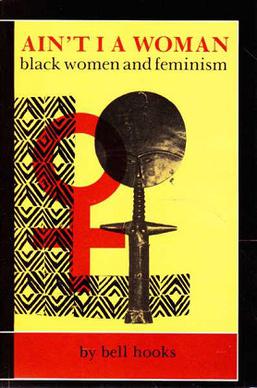
Ain’t I a Woman: Race, Gender, and Historical Erasure
The title of hooks’ first major book invokes Sojourner Truth’s famous speech. hooks demonstrates that Black women historically occupy a position distinct from both white women and Black men.
Under slavery, Black women were:
- Economically exploited
- Sexually violated
- Denied the ideology of “true womanhood” that shielded white women
White middle-class feminism, hooks argues, often ignored this history. The myth of universal sisterhood obscured racial hierarchy within feminist movements.
Thus, feminism must be re-centered from the margins.
From Margin to Center
In Feminist Theory: From Margin to Center, hooks critiques liberal feminism for focusing primarily on equality within existing capitalist structures. She insists that feminism must confront economic exploitation and racism.
Her argument reframes feminist criticism:
- Gender oppression cannot be isolated from class inequality.
- Literary representation must be analyzed within systems of production and consumption.
- The “woman” in feminist theory is not homogeneous subject.
hooks transforms feminist literary criticism into intersectional cultural critique.
Representation and the Oppositional Gaze
In Black Looks, hooks examines visual culture, film, and literature to theorize the “oppositional gaze.” Under slavery and segregation, Black people were punished for looking—gazing was an act of defiance.
Black spectatorship thus becomes resistant practice. Representation is not passive consumption but site of struggle.
Applied to literature, this insight demands reading from marginalized positionality. The reader’s social location matters.
Literary Implications
hooks’ framework reshapes literary analysis in several ways:
- Female characters must be analyzed not only as women but as racially and economically situated.
- Domestic ideology functions differently across racial lines.
- Respectability politics and sexual stereotypes intersect.
- Canon formation itself reflects racial exclusion.
For example, reading Toni Morrison’s novels through hooks’ lens highlights how motherhood, sexuality, and labor intersect under racialized capitalism.
Her work shifts feminist literary studies from universal abstraction to historical specificity.
Education and Feminist Pedagogy
In Teaching to Transgress, hooks extends feminist theory into classroom practice. Education becomes site of liberation rather than reproduction of hierarchy.
This pedagogical dimension distinguishes hooks from earlier critics. Feminist theory must transform institutions, not merely interpret texts.
Critique of White Feminism
hooks is unflinching in her critique:
- White feminists often ignored working-class women.
- Academic feminism sometimes detached from grassroots struggle.
- Patriarchy cannot be dismantled without confronting racism and capitalism.
Her intervention complicates earlier Anglo-American feminism, demanding reflexivity.
Intersectionality and Structural Analysis
Though the term “intersectionality” is more formally associated with Kimberlé Crenshaw, hooks’ work anticipates and operationalizes it within cultural criticism.
Gender is inseparable from race and class. Literary texts reflect overlapping systems.
This perspective transforms close reading into structural reading.
Comparison with Earlier Anglo-American Feminists
- Millett analyzes sexual domination but insufficiently addresses race.
- Showalter reconstructs women’s tradition but initially centers white British authors.
- Gilbert & Gubar read symbolic rage but do not foreground racial difference.
- hooks reframes feminism as multi-axis critique.
Her work expands the scope and ethical accountability of feminist literary studies.
hooks’ Contribution
bell hooks relocates feminist criticism from universal womanhood to intersectional struggle. She reveals that representation, authorship, pedagogy, and canon formation are embedded within racial and economic hierarchies.
Her feminism is activist, accessible, and theoretically rigorous.
Conceptual Summary Table
| Theoretical Axis | hooks’ Position | Literary Implication |
|---|---|---|
| Intersectionality | Gender, race, class interlocking | No universal “woman” |
| Representation | Site of racialized power | Oppositional reading practice |
| Canon | Racially structured | Recovery & critique required |
| Sexual Politics | Linked to white supremacy & capitalism | Multi-axis analysis |
| Pedagogy | Education as liberation | Classroom politicized |
| Method | Cultural + literary critique | Intersectional close reading |
Concluding Perspective
bell hooks completes the evolution of Anglo-American feminist criticism from ideological exposure (Millett), to literary historiography (Showalter), to psycho-symbolic analysis (Gilbert & Gubar), to intersectional structural critique.
Her work ensures that feminism remains accountable to race, class, and lived experience. Feminist literary criticism becomes not merely academic practice but transformative politics.
