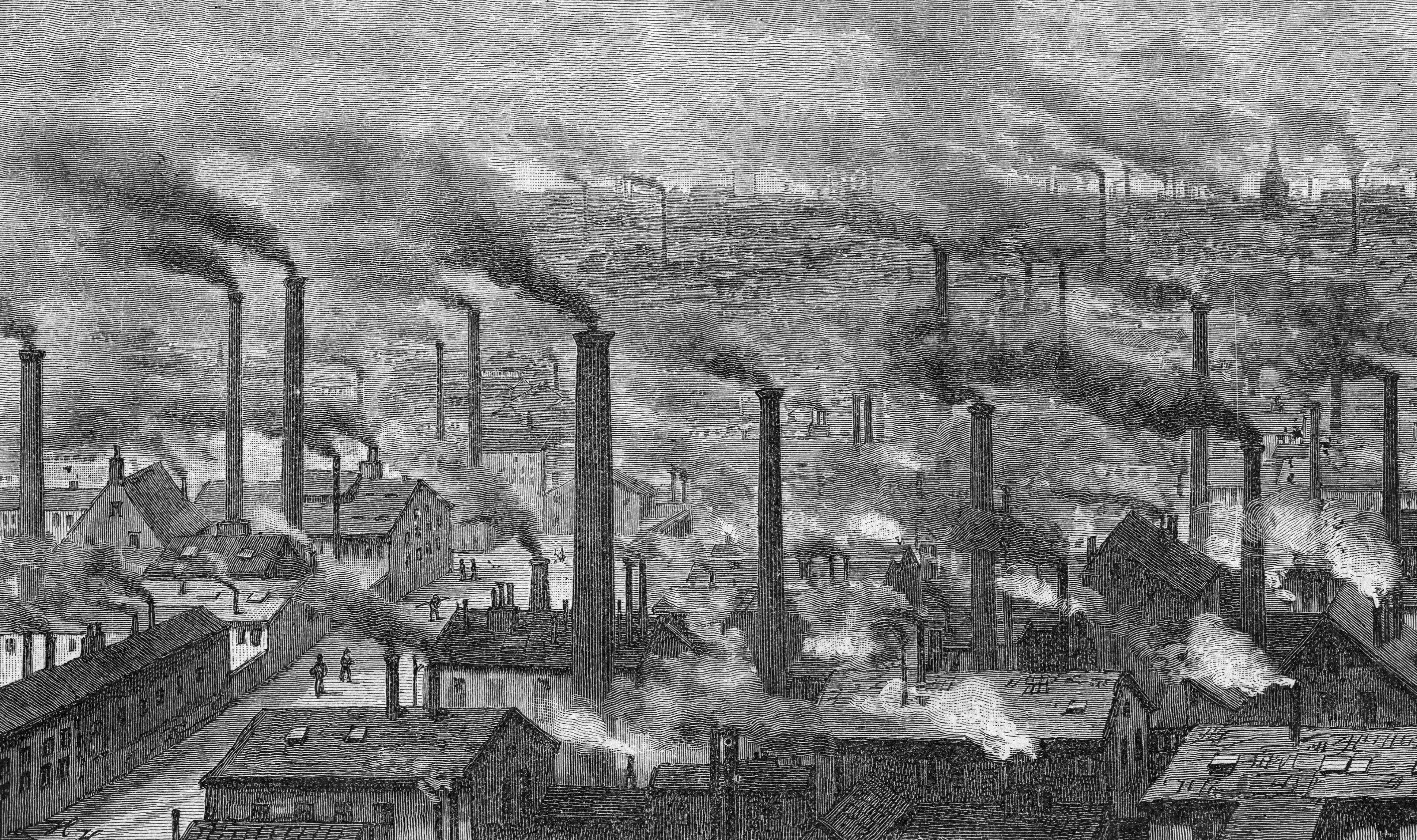
To continue our movement through realism beyond French and Russian traditions, we may turn to industrial England and to Hard Times by Charles Dickens. Though Dickens is sometimes associated with caricature and satire, Hard Times stands as one of the most concentrated examples of Victorian social realism. The novel embeds individual destinies within the machinery of industrial capitalism, educational reform, utilitarian philosophy, and class hierarchy.
If the social novel is realism’s most fitting genre, Hard Times demonstrates why: it binds private suffering to public structure. The fictional town of Coketown—modeled on industrial Manchester—becomes laboratory in which economic ideology shapes consciousness, marriage, morality, and imagination. The novel’s realism lies not merely in description of factories but in its depiction of how a philosophy of “Facts” reorganizes emotional life.
What follows is a sustained realist reading with extended development under each thematic heading.
I. The Industrial Novel and Realism’s Social Scope
Realism in mid-nineteenth-century England emerges alongside rapid industrialization. The factory system reorganized labor, urban life, and class relations. The industrial novel became realism’s instrument for examining these changes.
Hard Times is compact compared to Middlemarch, yet it retains realism’s essential features:
- Concrete depiction of working-class conditions
- Integration of political economy into narrative
- Interwoven class perspectives
- Psychological development shaped by ideology
- Causality grounded in social systems rather than fate
Dickens situates the narrative in Coketown, a city of red brick darkened by smoke, monotonous streets, and mechanized rhythms. The environment is not mere backdrop; it forms mental habits and social relations.
Realism here confronts industrial modernity.
II. Coketown: Environment as Social Condition
The opening description of Coketown establishes realism’s material grounding. The town is composed of identical streets, repetitive architecture, and factory chimneys. The air is thick with soot; the river runs purple with industrial dye.
Dickens describes factories operating like mechanical monsters—pistons moving up and down with relentless regularity. This imagery, though vivid, remains anchored in recognizable industrial detail. Workers stream in and out at fixed hours; bells regulate time.
Coketown’s uniformity produces psychological monotony. Realism insists that environment shapes consciousness. The city’s sameness mirrors Gradgrind’s educational philosophy and Bounderby’s economic rhetoric.
III. Thomas Gradgrind and Utilitarian Education
Gradgrind embodies the doctrine of utilitarianism: facts above imagination, statistics above sentiment. In the opening classroom scene, he demands children define a horse in precise empirical terms.
This educational system produces measurable knowledge but suppresses creativity. Dickens does not reject education; he critiques reduction of knowledge to quantifiable fact.
Gradgrind’s children—Louisa and Tom—are raised without fairy tales or emotional indulgence. Their inner lives become stunted. Realism appears in tracing consequences of ideology upon domestic relationships.
The novel dramatizes how abstract philosophy translates into concrete emotional deprivation.
IV. Louisa Gradgrind: Emotional Starvation
Louisa grows into woman trained to distrust feeling. She marries Josiah Bounderby, a wealthy industrialist, not out of affection but calculation. The marriage is presented as rational alliance consistent with utilitarian doctrine.
Yet Louisa’s interior emptiness intensifies. Dickens renders her dissatisfaction not through melodrama but through gradual scenes—her silence, her gaze into fire, her inability to articulate longing.
When James Harthouse attempts to seduce her, Louisa confronts crisis. She does not succumb physically; instead, she returns to her father in emotional breakdown. The scene is significant for realism: it dramatizes psychological collapse as product of upbringing.
Louisa’s suffering arises not from romantic destiny but from educational deprivation and social arrangement.
V. Josiah Bounderby: Self-Made Myth and Class Ideology
Bounderby boasts of rising from poverty without assistance. He narrates his own childhood as story of hardship overcome by industry. Later, the revelation that his mother provided care exposes his self-made myth.
Dickens critiques bourgeois ideology that glorifies individual success while ignoring structural advantage. Bounderby’s arrogance toward workers stems from belief in meritocracy.
Realism lies in linking character psychology with economic rhetoric. Bounderby’s persona reflects industrial capitalism’s moral self-justification.
VI. Stephen Blackpool: Working-Class Integrity
Stephen Blackpool, a factory worker, represents laboring class experience. He is trapped in loveless marriage, unable to obtain divorce due to legal restrictions that favor the wealthy.
His moral integrity contrasts with industrial exploitation. When workers consider forming union, Stephen hesitates—not because he supports management but because he fears conflict.
Stephen’s isolation exposes class vulnerability. His eventual dismissal from factory, wrongful suspicion in bank robbery, and accidental death in abandoned mine shaft reveal precariousness of working-class life.
Dickens does not romanticize poverty; he shows its material danger and legal constraint.
VII. The Robbery and Social Suspicion
Tom Gradgrind, embittered and irresponsible, robs Bounderby’s bank. Suspicion falls on Stephen, whose previous dismissal and social marginality make him convenient scapegoat.
The episode demonstrates realism’s attention to social prejudice. Institutions assume guilt based on class position.
Tom’s eventual exposure implicates utilitarian upbringing. Deprived of moral imagination, he becomes self-serving and reckless.
Crime here is not innate degeneracy; it is cultivated through emotional neglect.
VIII. Sissy Jupe: Imagination as Counterforce
Sissy Jupe, daughter of circus performer, enters Gradgrind household after her father disappears. She embodies imagination, empathy, and warmth—qualities excluded from Gradgrind pedagogy.
Her inability to define a horse according to utilitarian terms initially marks her as deficient. Yet over time, she proves morally perceptive and emotionally resilient.
Sissy’s presence reveals alternative model of education grounded in compassion rather than calculation. Realism allows coexistence of contrasting social philosophies.
IX. Gender, Marriage, and Legal Constraint
Marriage in Hard Times reflects Victorian legal norms. Louisa’s inability to dissolve marriage with Bounderby without scandal illustrates institutional rigidity. Stephen’s marital entrapment underscores class-based inequality in access to divorce.
Realism foregrounds such legal asymmetries. Personal happiness is circumscribed by law.
X. Narrative Voice and Social Critique
Dickens employs third-person narration infused with irony. He exaggerates certain traits—Bounderby’s bluster, Gradgrind’s rigidity—yet the social conditions remain plausible.
The satire sharpens realism rather than undermines it. The caricature amplifies structural critique.
XI. Industrial Capitalism and Moral Vacuum
Factories produce wealth but erode community. Workers reduced to “Hands” lose individuality. Dickens emphasizes dehumanizing language.
Realism here critiques system through specific depiction—factory hours, labor disputes, financial speculation.
XII. The Ending: Reform without Revolution
Gradgrind eventually renounces strict utilitarianism. Louisa remains childless but gains deeper emotional understanding. Tom dies abroad after exile. Bounderby dies suddenly.
Stephen’s innocence is recognized posthumously. Yet Coketown continues industrial rhythm.
Realism rarely offers utopian transformation. Instead, it offers measured reform.
XIII. Realism versus Naturalism
Unlike naturalism, which might emphasize deterministic forces beyond reform, Hard Times retains moral agency. Characters can learn, albeit slowly.
Unlike romanticism, it refuses to elevate passion into destiny. Louisa’s crisis resolves not through elopement but introspection.
XIV. Conclusion
A realist reading of Hard Times reveals the industrial novel as instrument of social analysis. Dickens integrates economic ideology, legal constraint, educational philosophy, and domestic suffering into coherent narrative.
Coketown’s smoke, Gradgrind’s facts, Stephen’s toil—these elements ground the story in material reality. The novel demonstrates how realism examines structures that shape feeling.
The social novel remains realism’s ideal genre because it can contain factories and families, laws and longing, statistics and tears within the same narrative field.
📊 Summary Table: Realist Reading of Hard Times
| 🟦 Category | 🟩 Realist Principle | 🟨 Textual Illustration | 🟥 Critical Insight |
|---|---|---|---|
| 🏭 Industry | Material environment | Coketown factories | Setting shapes consciousness |
| 📚 Education | Ideological influence | Gradgrind’s classroom | Philosophy affects emotion |
| 💍 Marriage | Legal constraint | Louisa–Bounderby union | Institution limits autonomy |
| 💰 Class | Economic hierarchy | Stephen’s dismissal | Workers vulnerable |
| 🧠 Psychology | Gradual consequence | Louisa’s breakdown | Upbringing determines crisis |
| 🏦 Crime | Social suspicion | Bank robbery | Class prejudice shapes blame |
| 🎪 Imagination | Moral counterpoint | Sissy Jupe | Empathy as corrective |
| ⚖ Law | Institutional asymmetry | Divorce restrictions | Inequality codified |
| 🔄 Ending | Limited reform | Gradgrind’s change | Realism avoids utopia |
| 📌 Genre | Industrial social novel | Multi-class depiction | Breadth enables critique |