Émile Zola’s Germinal occupies a singular place in Marxist literary analysis because it dramatizes capitalism not as moral failure but as systemic structure. Unlike Dickens’s ethical critique in Hard Times, Zola presents industrial exploitation as historically determined, materially grounded, and collectively experienced. The novel stages not only alienation but the formation of class consciousness; not only suffering but revolutionary potential.
Read through Marxist theory—particularly historical materialism, alienation, class struggle, ideology, and the emergence of collective subjectivity—Germinal becomes more than naturalist documentation. It becomes an epic of proletarian becoming.
I. Historical Materialism and the Determinism of Conditions
Marx’s historical materialism posits that material conditions—the mode of production and relations of labor—shape social institutions, ideology, and consciousness. In Germinal, the mining town of Montsou is structured entirely around coal extraction. Housing, diet, sexuality, illness, and even imagination are conditioned by the mine.
The Voreux mine itself functions as a material base in the strict Marxian sense. It determines the superstructure: family arrangements, religious authority, managerial hierarchy, even interpersonal rivalry. Zola’s descriptive density—claustrophobic tunnels, mechanical rhythm of descent, the omnipresence of coal dust—underscores that labor is not backdrop but structuring force.
Unlike liberal narratives of individual advancement, Germinal denies the illusion of mobility. Workers inherit not merely poverty but position within relations of production. The Maheu family exemplifies generational entrapment. Labor is not contract between free agents; it is structural necessity enforced by economic survival.
Zola’s naturalism aligns with Marx’s determinism: human character is not purely moral but materially conditioned. Desire, conflict, and even revolt arise from economic arrangement.
II. Alienation and the Body
Marx’s early manuscripts describe alienation as estrangement from product, process, species-being, and fellow workers. In Germinal, alienation is visceral. Miners descend into darkness before dawn; they emerge physically deformed, prematurely aged, spiritually exhausted.
The product of their labor—coal—does not belong to them. It fuels bourgeois comfort. The separation between laboring body and consumed commodity dramatizes alienation in concrete form. Workers experience labor as coercion rather than self-realization.
Zola intensifies this through corporeal imagery. The mine consumes bodies. It is feminized as devouring womb, yet also mechanized monster. Labor under capitalism appears not merely exploitative but dehumanizing.
Alienation extends beyond work. Scarcity invades domestic life. Sexual relationships are strained by poverty. Hunger becomes structural motif. The body becomes the site where economic relations manifest.
III. From Individual Despair to Collective Consciousness
Where Hard Times isolates Stephen Blackpool, Germinal foregrounds collective experience. Marx argues that a class becomes revolutionary when it transforms from “class in itself” (objective position within production) to “class for itself” (self-conscious political actor).
Étienne Lantier’s arrival catalyzes this transformation. Influenced by socialist ideas, he articulates exploitation in theoretical terms. Yet Zola resists romanticizing him. Étienne is both visionary and flawed, subject to jealousy and error. Class consciousness emerges unevenly, through debate, rumor, and shared suffering.
The strike marks a decisive shift. Workers move from isolated endurance to organized refusal. Hunger radicalizes them. The collective body replaces individual resignation. This is Marx’s dialectic made narrative: material deprivation generates awareness of structural injustice.
However, Zola does not present revolution as triumphant inevitability. The strike collapses under repression and scarcity. Class consciousness is embryonic, not victorious. Yet its emergence marks historical movement.
IV. Ideology and False Hope
Marx emphasizes that ideology obscures exploitation by presenting existing conditions as natural or inevitable. In Germinal, religious consolation and managerial paternalism function ideologically.
The Church encourages resignation. The mining company portrays itself as benefactor, distributing minimal aid to mask structural extraction. Workers internalize shame for their poverty. Such internalization reflects what later Marxists would call false consciousness: misrecognition of systemic causality.
Yet ideology weakens as hunger intensifies. Material crisis destabilizes belief. Zola shows ideology not as static illusion but as historically contingent—vulnerable to contradiction.
V. Violence and Revolutionary Energy
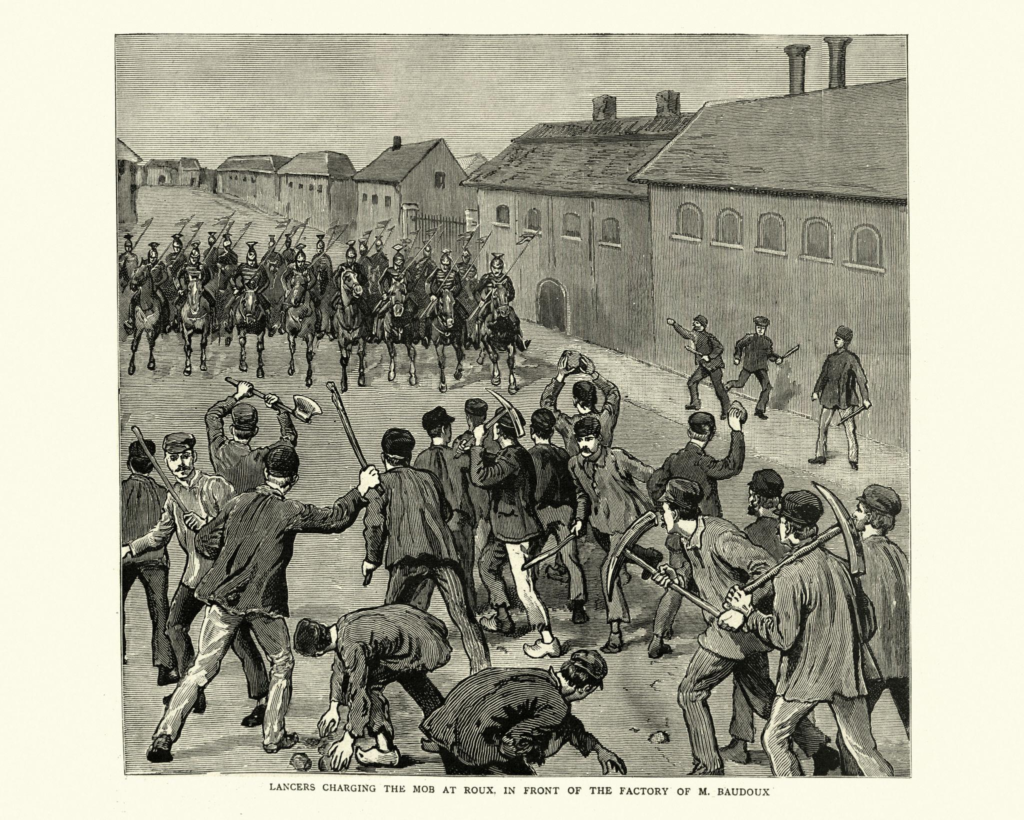
The strike escalates into riot. Machinery is destroyed; confrontation with troops turns deadly. Marxist theory views violence not as moral aberration but as symptom of irreconcilable class antagonism. When exploitation reaches unbearable intensity, conflict becomes open.
Zola portrays violence ambivalently. It is both eruption of justified rage and descent into chaos. Revolutionary energy risks self-destruction. This ambivalence prevents simplistic propaganda reading. The novel recognizes that structural injustice breeds fury, but fury alone cannot sustain political transformation.
The repression of the strike underscores state alignment with capital. Military intervention reveals that the state protects property relations. Marx’s assertion that the state serves ruling-class interests finds concrete representation.
VI. Nature, Determinism, and the Seeds of Future Revolution
The novel concludes not with triumph but with subterranean rumbling. The metaphor of germination—suggested in the title—invokes seeds lying dormant beneath soil. Defeat does not extinguish revolutionary potential; it plants it.
Here Zola synthesizes determinism with hope. Historical materialism implies that capitalism generates its own gravediggers. The miners’ experience, though crushed, accumulates memory. Class consciousness, once awakened, cannot fully recede.
The final imagery of rising workers parallels Marx’s metaphor in The Communist Manifesto: the proletariat as emergent historical force. Zola transforms economic theory into organic metaphor.
VII. Lukács and Totality
Georg Lukács argued that realist fiction achieves greatness when it reveals social totality—the interdependence of individual fate and structural conditions. Germinal exemplifies this criterion.
Characters are not isolated psychologies but nodal points within economic network. Owners, engineers, priests, merchants, workers—each participates in total structure. The novel demonstrates how base (production) shapes superstructure (culture, morality, belief).
Zola’s naturalist detail does not fragment reality; it integrates it. The strike is not anecdote but systemic expression. The mine is both workplace and symbol of capitalist totality.
VIII. Reform or Revolution?
Unlike Dickens, Zola moves closer to revolutionary horizon. Yet he stops short of endorsing clear political program. The strike fails. Leaders quarrel. Workers suffer.
This restraint may reflect historical caution. It also preserves analytic realism. Marxist theory recognizes that revolutionary transformation requires objective and subjective conditions. In Germinal, conditions ripen but remain incomplete.
The novel’s power lies precisely in this tension: capitalism appears unsustainable, yet revolution remains deferred.
Conclusion: The Epic of Proletarian Becoming
Germinal stands as perhaps the most compelling nineteenth-century fictional embodiment of Marxist principles. It dramatizes:
- Material determinism shaping consciousness
- Alienation of labor in bodily terms
- Ideological mystification and its breakdown
- Emergence of class consciousness
- Structural antagonism between capital and labor
Zola transforms economic critique into narrative epic. The miners are not merely victims; they are historical agents in formation. Though defeated, they signify the future inscribed within capitalism’s contradictions.
Where Dickens critiques industrialism ethically, Zola situates it historically. The difference marks the shift from liberal reformism to proto-revolutionary realism.