Central argument
A New Historicist reading treats Heart of Darkness less as an abstract allegory of “evil in the human heart” and more as a cultural artifact produced inside a specific imperial conjuncture: late-Victorian corporate colonialism, humanitarian publicity campaigns, and metropolitan reading publics hungry for “Africa” as both commodity and spectacle. My claim is sharp: Conrad’s novella stages the way imperial power converts violence into discourse—reports, euphemisms, “civilizing” rhetoric, managerial paperwork—and then shows how that discourse breaks down under the pressure of what it must hide. The “horror” is not simply Kurtz’s private abyss; it is the disclosure that imperial sovereignty is a rhetorical technology masking extraction.
This is why the book’s formal choices matter historically: the frame narrative on the Thames, the layered narration (Marlow mediated by an unnamed auditor), the obsessive vocabulary of “darkness,” “silence,” and “unspeakable,” and the managerial lexicon of “stations,” “agents,” “pilots,” “ivory.” Form here is not ornament; it is how empire speaks.
1) The Congo Free State as historical matrix: extraction disguised as mission
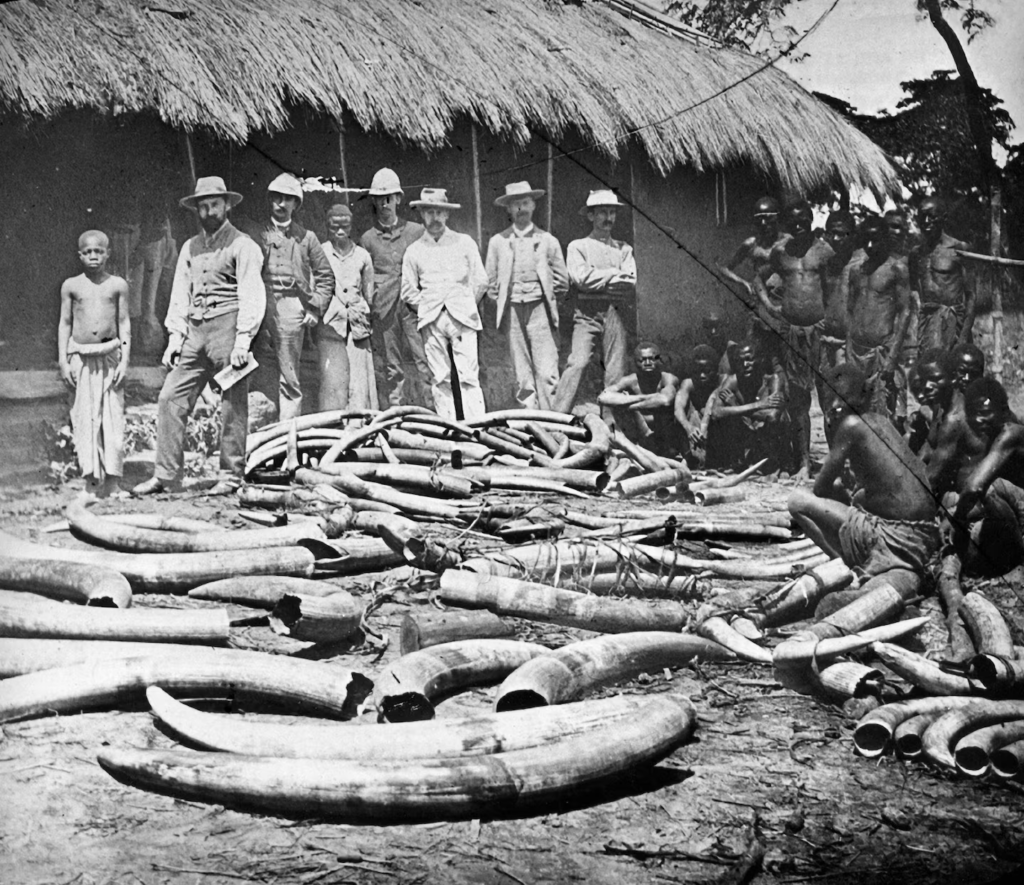
The novella’s Congo is not a generic Africa. It resonates with the Congo Free State, established in 1885 as King Leopold II’s personal possession and administered through concessionary arrangements that extracted ivory and rubber by coercion and terror while presenting itself as humanitarian modernization.
A New Historicist approach does not require the novel to be a documentary to insist on this: it asks how a text circulates within these institutional realities—charters, companies, missionary talk, press scandals, atrocity photographs, parliamentary debates. The novel’s obsession with “ivory” is a historical fingerprint: the commodity is not incidental, it is the plot’s economic motor (Kurtz’s greatness equals his output). The Company’s map-and-station apparatus likewise echoes the real imperial grammar of “posts,” “routes,” “interiors,” and “management.”
Conrad’s own proximity to this matrix is part of the production context: in 1890 he served a Belgian trading company in the Congo and later drew on his journals when writing the novella. The point is not biographical reduction (“he saw it, therefore he wrote it”) but discursive location: the text is written from within the very administrative-capitalist networks it anatomizes.
2) Company-sovereignty: when commerce becomes government
One of the most New-Historicist features of Heart of Darkness is its vision of empire as a hybrid regime where corporation and state interpenetrate. The Company is not merely a business; it governs territory, bodies, and meaning. It produces:
- space (stations, routes, the river as logistical artery),
- time (deadlines, quotas, delays as structural violence),
- knowledge (reports, “proper” accounts, managerial evaluations),
- subjectivity (Europeans as “agents,” Africans as “labor,” “bodies,” “shadows”).
The Administrative is the novel’s true antagonist: the “Outer Station” with purposeless blasting and derelict machinery is not just satire; it is a portrait of imperial modernity as infrastructural theater—a performance of development whose real function is to secure extraction. New Historicism emphasizes precisely this: power is sustained not only by force but by ritualized procedures and forms of representation.
Kurtz’s “success” exposes the logic: he is not a mad exception but the system’s distilled truth. He carries the civilizing vocabulary (eloquence, ideals, uplift) while converting it into absolute rule. In other words, Kurtz is what happens when the Company’s implicit sovereignty becomes explicit.
3) Kurtz as a node of imperial discourse, not merely a psychological case
Traditional readings often make Kurtz a psychological emblem: a man who “goes native,” a soul unmoored. New Historicism relocates Kurtz: he is a discursive function. The text repeatedly stresses his voice, his “gift of expression,” his report-writing, his capacity to generate belief. He is a producer of ideology.
That famous report for the “International Society for the Suppression of Savage Customs” (and its obscene scrawl at the end) matters because it captures empire’s core contradiction: the civilizing mission requires a rhetoric of uplift, but the extractive reality requires terror. The report is the textual form in which this contradiction is managed—until it cannot be managed and collapses into naked command.
So Kurtz is not simply the “heart of darkness.” He is empire’s charismatic endpoint: the man who can translate violence into idealism and idealism back into violence, depending on what the system requires.
4) Marlow and the compromised witness: narration as imperial technology
New Historicism is especially attentive to who gets to speak, under what conditions, and with what institutional pressures. Marlow is not an innocent truth-teller. He is a functionary-witness: he works within the Company’s logistics, depends on its routes, and interprets the Congo through the available metropolitan categories.
The novella’s famous indirections—hesitations, refusals to describe, reliance on metaphor (“like,” “as if”), repeated claims that it is “impossible” to convey—are not merely aesthetic modernism. They are historically meaningful signs of an imperial situation where the truth is structurally unsayable: unsayable because it would indict the entire enterprise, including the listener’s world on the Thames.
This is why the frame matters. The story begins not in Africa but on the Thames—imperial river answering colonial river. The metropole is not outside the horror; it is its administrative and financial origin. In New Historicist terms, the frame performs a crucial ideological maneuver: it makes the Congo a “there,” but then quietly re-situates it as a mirror of “here.”
5) Darkness as a political metaphor: from racial trope to epistemology of rule
A careful New Historicist reading does not deny the novella’s racialized imaginary; rather, it asks what that imaginary does historically. “Darkness” operates on multiple registers:
- Geopolitical: “the interior” as blank space to be penetrated—an imperial cartographic fantasy.
- Administrative: opacity of what the Company does beyond the reach of metropolitan oversight.
- Epistemological: the failure of European categories—progress, civilization, work, morality—to account for what is happening.
- Affective: dread, fascination, desire—what empire produces in its own agents.
This is the crucial shift: darkness is not only about Africans (though the text participates in that history of representation); it is also about the darkness of the imperial archive—the systematic production of ignorance, euphemism, and plausible deniability. New Historicism highlights precisely this: power does not merely repress; it organizes knowledge and strategically manufactures non-knowledge.
6) Humanitarianism, publicity, and the politics of reform
By the early twentieth century, international scrutiny of Congo abuses intensified through reports and campaigns; Roger Casement’s 1904 report and E. D. Morel’s activism culminated in the Congo Reform Association (founded 1904), which used publicity—including atrocity photographs—to pressure reform.
Even though Heart of Darkness predates much of this organized reform effort, a New Historicist lens helps you see the novella as part of the pre-history of humanitarian public culture: it belongs to a moment when metropolitan audiences could begin to consume imperial critique without abandoning imperial frameworks. That tension is built into Marlow’s final lie to the Intended: private consolation replaces public truth; imperial ideology is repaired at the level of sentiment.
The lie is not a mere moral flaw. It is an ideological act: the metropolitan feminine domestic sphere (the Intended, the drawing room, the cult of noble sacrifice) is preserved as the affective foundation of empire. Truth would corrode the emotional infrastructure that makes the imperial project livable for those who benefit from it.
Conclusion: what the novella finally exposes
In New Historicist terms, Heart of Darkness is a text about how empire stabilizes itself through narrative—and about how that stabilization fails. The novella does not simply tell us “colonialism is bad.” It anatomizes the cultural machinery that allows colonialism to persist: corporate sovereignty, charismatic ideology, managerial euphemism, metropolitan sentiment, and the controlled circulation of “truth” as rumor.
Kurtz’s collapse is therefore not the exception; it is the revelation. The system produces Kurtz because it requires him: a man who can turn extraction into idealism and idealism into extraction. Marlow’s narration, with its hesitations and silences, is the form that a compromised witness must take when speaking from inside an imperial archive built to prevent full intelligibility.
Summary table
| Analytical focus | What happens in the text | New Historicist payoff | Key historical linkage |
|---|---|---|---|
| Congo as archive of extraction | Stations, “ivory,” forced labor imagery, bureaucratic decay | Empire as a material-discursive system, not backdrop | Congo Free State extraction regime under Leopold II |
| Company-sovereignty | Commerce governs territory, bodies, meaning | Corporate power as political sovereignty | Concessionary/corporate colonial administration |
| Kurtz as discourse-machine | “Voice,” report-writing, charisma, final command | Ideology as a technology of rule | “Civilizing mission” rhetoric underwriting coercion |
| Marlow as compromised witness | Indirection, silence, mediation, final lie | Truth is institutionally constrained; narration is political | Metropolitan audiences and imperial sentiment |
| Frame on the Thames | Congo “there” returns to London “here” | Metropole and colony form one circuit | Imperial finance/administration anchored in Europe |
| Reform/publicity horizon | Atrocity talk as rumor; later campaigns | Critique can be consumed and contained | CRA, Casement/Morel reform politics |
| Publication situation | Serial form; late-Victorian readership | Text as commodity circulating in print culture | First serialized 1899; later collected 1902 |