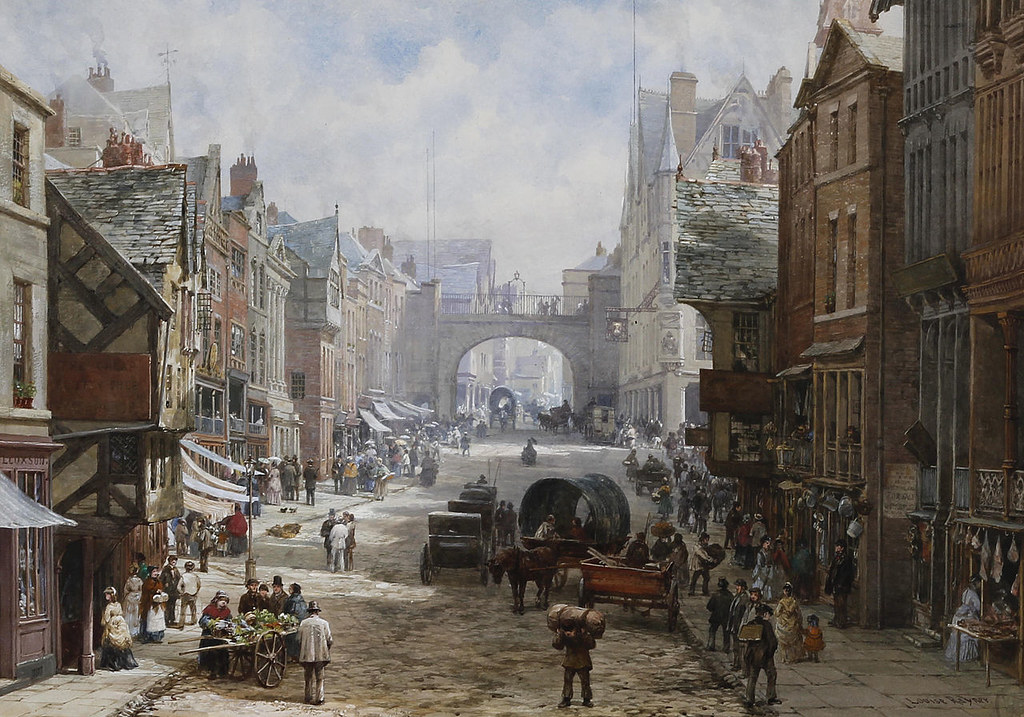
To move from Impressionism to Realism is to shift from the shimmer of perception to the density of social fact. Where impressionism privileges fleeting sensation, realism seeks durable structures: class, economy, marriage, law, property, institutional life. The genre that most fully accommodates realism is the social novel—particularly the nineteenth-century panoramic novel that integrates multiple characters, intersecting plots, and detailed socio-historical context.
If realism aims to render society in its thickness—its habits, constraints, and moral negotiations—then the large-scale social novel is its most suitable vehicle. It provides room for:
- Interlocking plotlines
- Complex psychological development
- Economic and institutional detail
- Ethical commentary
- Social causality
Few works embody this genre more fully than Middlemarch by George Eliot. Subtitled A Study of Provincial Life, the novel stands as a monumental example of realism—not because it rejects imagination, but because it anchors imagination in social texture.
The following study offers a detailed realist reading of Middlemarch, demonstrating why the social novel is realism’s most comprehensive form.
I. Why the Social Novel Best Suits Realism
Realism as a literary movement, emerging prominently in the mid-nineteenth century, aims to depict ordinary life without romantic idealization or melodramatic exaggeration. It seeks probability, social embeddedness, moral ambiguity, and psychological depth.
The short story can render realistic scenes, but it lacks panoramic range. Drama can present social conflict, but it often condenses action. The long novel, however, allows realism to develop its full apparatus:
- Historical context (e.g., Reform Bill politics)
- Economic structures (inheritance, property, debt)
- Institutional frameworks (marriage law, medical practice)
- Community networks (gossip, reputation, patronage)
Middlemarch exemplifies this breadth. It does not focus solely on one protagonist; it interweaves several lives, showing how individual aspirations collide with provincial reality.
Realism thrives on interdependence. The social novel makes that interdependence visible.
II. Historical and Social Context
The novel is set in the fictional Midlands town of Middlemarch between 1829 and 1832, a period marked by debates over parliamentary reform. This historical anchoring is not decorative. It shapes character motivations and social tensions.
Political reform becomes a background hum affecting local alliances. Economic transformation—railways, changing agricultural practices—alters class structures. Medicine is undergoing transition from amateurism to scientific professionalism.
Realism requires such contextual embedding. Eliot situates personal dramas within historical movement, resisting isolation of psychology from society.
III. Dorothea Brooke: Idealism Meets Provincial Constraint
Dorothea Brooke enters the novel as idealistic young woman longing for moral and intellectual purpose. She desires to transcend trivial domesticity. Her choice to marry Edward Casaubon, an older scholar, reflects her aspiration toward spiritual partnership.
Yet Casaubon proves emotionally barren and intellectually obsolete. His “Key to All Mythologies” represents outdated scholarly ambition disconnected from contemporary research.
The realism lies not in condemning Dorothea’s naivety but in tracing how her aspiration collides with social reality. Marriage law binds her legally and economically. Casaubon’s insecurity manifests in coldness and suspicion. Dorothea’s awakening unfolds gradually as she confronts limits of idealized marriage.
Eliot does not stage dramatic rebellion. Instead, she charts psychological recalibration within realistic constraints.
IV. Edward Casaubon: Intellectual Failure as Social Type
Casaubon is not villain but tragic realist figure—an aging scholar whose project is rendered obsolete by modern philology. His insecurity emerges from social change rather than innate cruelty.
Realism allows such nuance. Casaubon’s jealousy toward Will Ladislaw stems from fear of intellectual irrelevance. His cold demeanor reflects thwarted ambition.
Eliot portrays him sympathetically even while exposing his limitations. Realism resists caricature.
V. Tertius Lydgate: Professional Ambition and Social Resistance
Lydgate represents scientific modernity. Educated in Paris, he arrives in Middlemarch determined to reform medical practice. He believes in empirical research and professional integrity.
However, provincial society resists innovation. Lydgate’s marriage to Rosamond Vincy entangles him financially. Debt accumulates. Social gossip erodes his authority. Eventually, he compromises with local power structures.
Lydgate’s trajectory illustrates realism’s core insight: individual aspiration is shaped—and often curtailed—by social environment.
VI. Rosamond Vincy: Social Aspiration and Gender Performance
Rosamond is often judged as shallow, yet realism complicates her portrayal. She embodies internalization of genteel femininity. Her education emphasizes accomplishment over autonomy.
Her desire for status and refinement drives her decisions. She perceives marriage as pathway to elevation. When Lydgate’s finances falter, she retreats into passive resistance.
Rosamond is not villain but product of social conditioning. Realism foregrounds this conditioning.
VII. Fred Vincy and Mary Garth: Economic Maturation
Fred Vincy begins as irresponsible young man, dependent on family support. His love for Mary Garth matures him gradually. Through financial missteps and humility, he learns discipline.
Mary’s practicality contrasts with Dorothea’s idealism. She embodies grounded realism—valuing honesty over romantic fantasy.
Their subplot offers counterpoint to Dorothea and Lydgate. Realism thrives on such varied trajectories.
VIII. Community as Web of Interdependence
One of the most striking realist features of Middlemarch is its depiction of community as interconnected web. Gossip circulates rapidly; reputations shift; economic decisions ripple outward.
Bulstrode’s scandal demonstrates this interdependence. His past financial misconduct surfaces, affecting Lydgate’s career due to association. Individual reputation becomes communal property.
Realism insists that no character exists in isolation.
IX. Marriage as Social Institution
Marriage in Middlemarch is not purely romantic union but legal and economic contract. Dorothea’s inheritance is constrained by Casaubon’s will. Lydgate’s debt implicates Rosamond.
Eliot explores the tension between affection and obligation. Marriage structures opportunity and limitation.
Realism attends to such institutional realities rather than abstract love.
X. Narrative Voice and Moral Commentary
Eliot’s narrator intervenes periodically with reflective commentary. These passages broaden perspective beyond immediate scene.
The narrator’s sympathy extends even to flawed characters. This ethical generosity exemplifies realist method: understanding precedes judgment.
XI. Psychological Depth Without Melodrama
Realism avoids sensational extremes. Casaubon’s death, for instance, occurs without dramatic spectacle. Dorothea’s grief unfolds quietly.
Lydgate’s professional disappointment emerges gradually. The novel favors accumulation over climax.
XII. The Reform Bill and Political Texture
Political reform debates permeate background. Characters align differently. Mr. Brooke’s inconsistent candidacy satirizes shallow liberalism.
Historical specificity grounds narrative in real societal transformation.
XIII. The Ending: Ordinary Lives, Enduring Impact
The novel concludes not with triumphant resolution but with measured outcomes. Dorothea marries Will Ladislaw and channels her idealism into supportive partnership. Lydgate becomes respected physician but never fulfills early research ambitions.
The final chapter reflects on “unhistoric acts” that shape world quietly. Realism affirms significance of ordinary life.
XIV. Realism Versus Romanticism
Unlike romantic fiction, Middlemarch resists exceptional heroism. Characters are neither purely virtuous nor villainous. Social forces mediate aspiration.
The novel dismantles illusions gently rather than dramatically.
XV. Why the Social Novel Remains Realism’s Ideal Form
Through multiple plotlines, historical context, economic detail, and psychological nuance, Middlemarch demonstrates the social novel’s capacity to render reality in full dimension.
Realism requires breadth. It requires duration. It requires community.
The genre of the long social novel provides these conditions.
Conclusion
A realist reading of Middlemarch reveals literature’s capacity to depict society in motion. Eliot integrates personal aspiration with institutional constraint, historical change with intimate feeling. Her characters are shaped by marriage law, inheritance, political reform, and economic necessity.
The novel’s greatness lies not in sensational drama but in faithful rendering of ordinary struggle. Realism here becomes ethical project: to see individuals as products of circumstance yet capable of moral growth.
The social novel remains realism’s most suitable genre because it alone accommodates this complexity—because it can hold entire communities within its pages.
📊 Summary Table: Realist Reading of Middlemarch
| 🟦 Category | 🟩 Realist Principle | 🟨 Textual Example | 🟥 Critical Insight |
|---|---|---|---|
| 🏘 Community | Social interdependence | Bulstrode scandal | Individuals shaped by networks |
| 💍 Marriage | Institutional constraint | Dorothea–Casaubon union | Law structures emotion |
| 💰 Economy | Material causality | Lydgate’s debt | Finance determines fate |
| 🗳 Politics | Historical embedding | Reform Bill debates | Personal lives within history |
| 🧠 Psychology | Moral complexity | Casaubon’s insecurity | Sympathy without simplification |
| 👩 Gender | Social conditioning | Rosamond’s ambition | Identity shaped by norms |
| 🌱 Growth | Gradual maturation | Fred’s development | Change through experience |
| 📖 Narrative | Reflective commentary | Authorial interventions | Ethical realism |
| ⚖ Ending | Ordinary resolution | Dorothea’s “unhistoric acts” | Realism honors the everyday |
| 📌 Genre | Social novel | Multi-plot structure | Breadth enables realism |