
The adjective “Kafkaesque” has entered critical vocabulary to describe situations marked by labyrinthine bureaucracy, opaque authority, existential dread, and surreal distortion. Yet to reduce the term to mere bureaucratic absurdity is to flatten its philosophical and literary density. The Kafkaesque names a distinctive aesthetic and ontological condition—one in which modern subjectivity confronts impersonal systems that are at once rationally structured and irrationally impenetrable.
Rooted in the fiction of Franz Kafka—especially novels such as The Trial and The Castle—the Kafkaesque is not simply a narrative style but a conceptual category for understanding modern alienation. It synthesizes existential anxiety, bureaucratic modernity, theological ambiguity, and expressionist distortion.
I. Historical Context: Modernity and the Rise of Bureaucracy
Kafka wrote in early twentieth-century Prague, a space marked by overlapping empires, linguistic plurality, and emerging administrative rationalization. The late Austro-Hungarian Empire and early modern Europe witnessed unprecedented growth in bureaucratic institutions—legal systems, insurance agencies, corporate structures.
Max Weber’s analysis of bureaucratic rationality—impersonal, rule-bound, procedural—forms an illuminating parallel. Yet Kafka reveals the dark underside of this rationalization. In The Trial, Josef K. is arrested without explanation; in The Castle, K. seeks access to opaque authority that never materializes. Procedures exist, but meaning does not.
The Kafkaesque thus arises from a paradox: hyper-rational systems produce irrational experience. Modern institutions promise order yet generate anxiety and disorientation.
II. Ontology of Absurdity
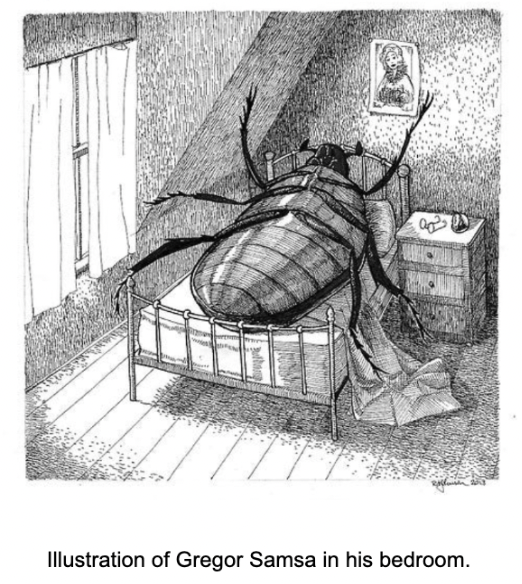
Unlike pure surrealism, Kafka’s worlds are internally coherent. The absurdity does not erupt chaotically; it unfolds through procedural normalcy. In The Trial, the arrest is carried out politely. In The Metamorphosis, Gregor Samsa’s transformation into an insect is treated as domestic inconvenience rather than metaphysical rupture.
This tonal restraint intensifies the effect. The extraordinary is normalized; the protagonist alone experiences ontological shock. The Kafkaesque is therefore not flamboyant fantasy but subdued estrangement.
Philosophically, this aligns with existential concerns later articulated by Albert Camus, who identified Kafka as precursor to the literature of the absurd. However, Kafka differs from Camus in that his worlds retain theological ambiguity. Authority may be arbitrary, but it is not necessarily meaningless; it is inscrutable.
III. Bureaucracy as Metaphysical Condition
In Kafka’s fiction, bureaucracy transcends administrative reality and becomes metaphysical structure. The court in The Trial is everywhere and nowhere—embedded in attics, hidden in tenements, omnipresent yet inaccessible.
Authority functions without transparency. Charges remain undefined; procedures lack closure. This produces what may be termed existential guilt—a sense of culpability detached from specific transgression.
The Kafkaesque therefore transforms legal logic into spiritual allegory. The subject internalizes accusation without knowing the crime. Guilt precedes action.
IV. Alienation and Fragmented Identity
4
Kafka’s protagonists are socially embedded yet profoundly isolated. Gregor Samsa supports his family; Josef K. works at a bank; K. in The Castle seeks employment. Yet institutional and familial structures fail to secure belonging.
Identity becomes unstable. Gregor’s physical metamorphosis literalizes psychological alienation. He is both self and object, human and vermin. The Kafkaesque often externalizes interior states through surreal embodiment.
Expressionist aesthetics are visible here: distorted architecture, claustrophobic corridors, looming authority figures. Space itself participates in oppression. Rooms shrink; ceilings press downward; doors multiply without exit.
V. Language and the Failure of Communication
Communication in Kafka’s works is structurally frustrated. Messages are delayed, misdirected, or encoded in inaccessible language. Letters in The Castle arrive without clarifying anything. Court officials speak in obfuscating jargon.
Language, which should mediate understanding, becomes instrument of opacity. This anticipates poststructural insights into the instability of meaning, yet Kafka does not celebrate indeterminacy. Instead, he dramatizes its anxiety.
The Kafkaesque subject is trapped in semiotic excess without semantic resolution.
VI. Theological Ambiguity
Critical debates often divide between existential and theological readings of Kafka. Some interpret the inaccessible authority as secular metaphor for modern bureaucracy; others detect negative theology—a hidden, silent God.
Kafka’s parables, such as “Before the Law,” complicate interpretation. The man waits lifelong before a door meant solely for him, yet never enters. The law exists, but access is perpetually deferred.
This ambiguity is central to the Kafkaesque. Authority is neither fully divine nor fully bureaucratic; it occupies liminal space between sacred and administrative.
VII. Stylistic Features of the Kafkaesque
The Kafkaesque aesthetic is marked by:
- Calm narration of extraordinary events
- Precise, almost clinical prose
- Labyrinthine spaces
- Authority without explanation
- Protagonist’s passive resistance
- Open or unresolved endings
Unlike dramatic tragedy, Kafka rarely provides cathartic closure. Josef K.’s execution is sudden, procedural, anticlimactic. The narrative ends without revelation.
VIII. Political and Modern Resonances
The Kafkaesque has been invoked to describe totalitarian regimes, surveillance states, and corporate bureaucracies. Yet Kafka’s work resists reduction to political allegory. His fiction predates twentieth-century totalitarianism, suggesting that the logic of administrative opacity is intrinsic to modernity itself.
In contemporary discourse, “Kafkaesque” describes situations where individuals confront faceless systems—immigration offices, insurance claims, algorithmic governance—where procedures exist but explanation does not.
Thus, the term has expanded beyond literature into socio-political vocabulary.
IX. Distinction from Absurdism and Surrealism
While often grouped with absurdist writers like Samuel Beckett, Kafka differs in tonal gravity. Beckett’s worlds emphasize minimalism and ontological void; Kafka’s worlds emphasize bureaucratic density.
Similarly, unlike surrealism, Kafka does not indulge dreamlike extravagance. The Kafkaesque is disciplined, structured, and juridical.
X. The Kafkaesque as Modern Condition
The Kafkaesque encapsulates a transformation in the conception of power. Authority no longer manifests as visible tyrant; it becomes diffuse, procedural, and anonymous. The subject internalizes anxiety not because of overt violence but because of structural opacity.
Modern life generates paradoxical experience:
- Rules exist but cannot be mastered.
- Institutions function yet lack transparency.
- Identity persists yet feels unstable.
Kafka’s genius lies in dramatizing this condition without offering interpretive closure.
Conclusion: Enduring Significance of the Kafkaesque
The Kafkaesque is not merely literary style but diagnostic category for modern existence. It captures the tension between rational systems and irrational experience, between institutional order and existential bewilderment.
In Kafka’s fiction, the individual confronts structures that are at once banal and metaphysical. Guilt is pervasive, meaning deferred, authority unreachable. The narrative world is coherent yet fundamentally opaque.
To call something Kafkaesque is to acknowledge that modernity has produced a new tragic form—one in which fate is replaced by file, oracle by office, and divine judgment by procedural uncertainty.
Kafka does not resolve this condition. He renders it visible. And in that visibility lies the enduring power of the Kafkaesque.
